
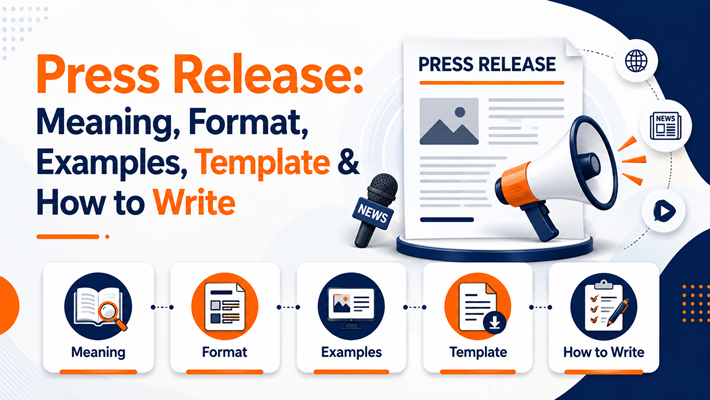
A press release is an official written announcement shared with journalists, editors, media outlets, and the public to communicate important news about a company, brand, organization, event, product, service, or public update.
Businesses use press releases to announce product launches, partnerships, funding, awards, events, leadership changes, financial updates, crisis responses, research reports, and other newsworthy developments.
A good press release gives the media a clear, factual, and ready-to-use story. It explains what happened, why it matters, who is involved, and how people can get more information.
Press releases are usually created by a company’s public relations or communications team. They may be shared directly with journalists, published on a company website, distributed through newswire services, or sent to industry publications.
This guide explains the meaning of a press release, its format, examples, template, writing process, distribution methods, SEO tips, and common mistakes to avoid.
Prefer watching instead of reading? Watch this complete video guide on press releases and learn the meaning, format, examples, template, writing process, distribution methods, and SEO tips in a simple and easy way.
Truth Box
| Key Point | Insight |
|---|---|
| Main purpose | A press release helps communicate newsworthy information to the media and public. |
| Best use | It works best for launches, events, partnerships, awards, funding, research, crisis updates, and major announcements. |
| Ideal style | A press release should be factual, concise, clear, and easy for journalists to understand. |
| SEO value | A press release can support brand visibility, referral traffic, media mentions, and search presence when used correctly. |
| Biggest mistake | Many press releases fail because they sound too promotional and do not offer real news value. |
What Is a Press Release?
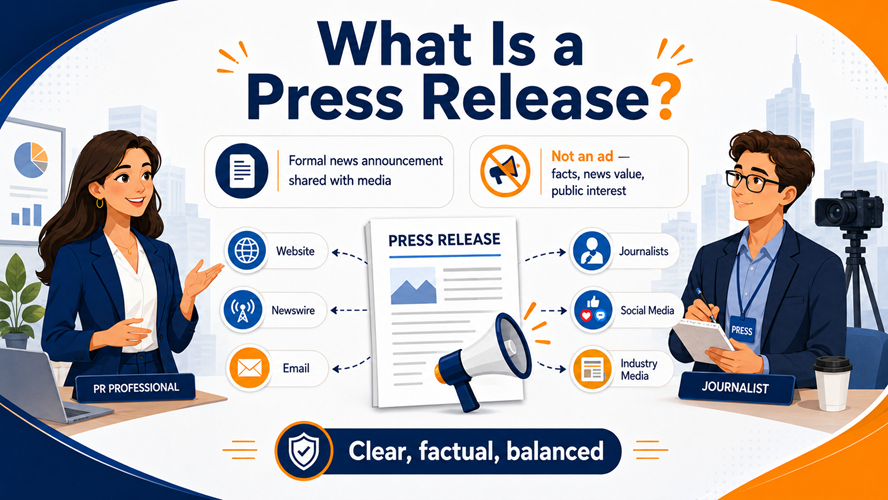
A press release is a formal news announcement written by a company, organization, government body, nonprofit, startup, brand, or individual to share important information with the media.
It is not the same as an advertisement. A press release should focus on facts, news value, and public interest. The goal is to help journalists understand the announcement quickly and decide whether it is worth covering.
In simple words:
A press release is an official statement issued to the media to announce an important event.
A press release can be shared through several channels.
| Channel | Purpose |
|---|---|
| Company website | To publish the announcement on owned media |
| Journalists and editors | To get media coverage |
| Newswire services | To distribute the release widely |
| Social media | To increase visibility |
| Email outreach | To pitch the story directly |
| Industry publications | To reach a targeted audience |
A press release is usually written by the company or organization making the announcement. Because of this, it should be factual, balanced, and clear instead of sounding like an advertisement.
Why Press Releases Are Important
Press releases are important because they help brands communicate news in a professional, clear, and structured way. When a company has something important to announce, a press release gives that announcement a proper format and makes it easier for journalists, editors, customers, investors, and the public to understand the story.
A well-written press release can help a business get media coverage by giving journalists the key details they need to create a news story. It can also increase brand awareness because more people get to know about the company, product, event, partnership, or update being announced. When a press release is picked up by media outlets or shared on trusted platforms, it can also improve credibility and build trust with the audience.
Press releases can also support online visibility. When published properly, they can help with branded search results, referral traffic, online mentions, and overall digital presence. They are also useful during sensitive situations because a company can share an official statement and control the message more clearly. For public companies, press releases are often used to communicate financial updates, investor-related announcements, or other material information.
Another major benefit of a press release is event promotion. If a company is hosting a conference, webinar, product launch, workshop, or public event, a press release can help attract attention and encourage media interest. Overall, press releases are useful because they give the media a complete package: the news, background context, quotes, company information, and contact details in one place.
When Should You Write a Press Release?
You should write a press release when your announcement is genuinely newsworthy.
Not every update needs a press release. A small discount, a routine blog post, or a general promotion may not be strong enough. The announcement should have clear value for your audience, industry, community, customers, investors, or the media.
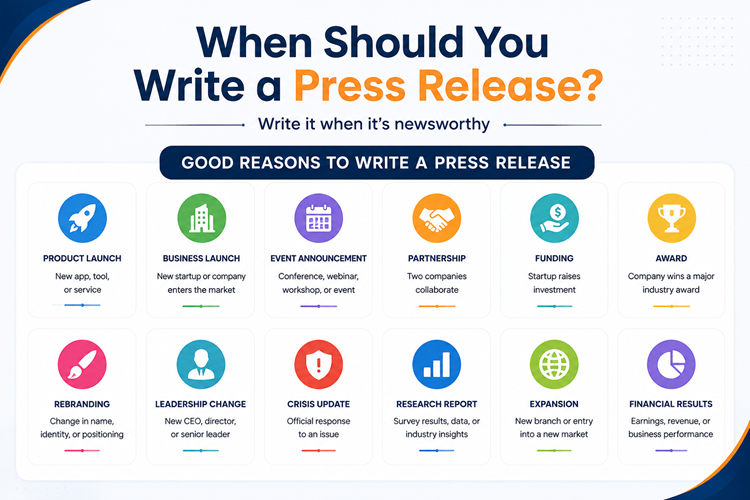
Good reasons to write a press release include:
| Situation | Example |
|---|---|
| Product launch | A company launches a new app, tool, or service. |
| Business launch | A new startup or company officially enters the market. |
| Event announcement | A brand announces a conference, webinar, workshop, or public event. |
| Partnership | Two companies collaborate on a new initiative. |
| Funding | A startup raises investment from investors. |
| Award | A company wins a major industry award. |
| Rebranding | A business changes its name, identity, or positioning. |
| Leadership change | A company appoints a new CEO, director, or senior leader. |
| Crisis update | A company shares an official response to an issue. |
| Research report | A brand publishes survey results, data, or industry insights. |
| Expansion | A company opens a new branch or enters a new market. |
| Financial results | A company announces earnings, revenue, or business performance. |
Types of Press Releases
There are many types of press releases, and the right type depends on the announcement you want to share. Every press release has the same basic goal: to communicate important news clearly to the media and the public. However, the structure, tone, and details may change depending on the purpose of the announcement.
A product launch press release is used when a company introduces a new product or service. It usually explains what the product does, who it is made for, why it matters, and where people can access it. An event press release is used to promote an upcoming event such as a conference, webinar, workshop, exhibition, product launch event, or public gathering. It should clearly mention the event date, location, audience, purpose, and registration details.
A business launch press release is written when a new company, startup, or brand enters the market. This type of release introduces the business, explains what it offers, and highlights the problem it aims to solve. A partnership press release is used when two or more companies collaborate on a new project, service, product, or initiative. It explains the purpose of the partnership and how it will benefit customers, users, or the industry.
A funding press release is commonly used by startups and growing companies to announce new investment or fundraising news. It usually includes the funding amount, investor details, business growth plans, and future goals. An award press release announces recognition, achievements, rankings, certifications, or industry honors. This type of press release helps build credibility and trust.
A rebranding press release is used when a company changes its name, logo, visual identity, messaging, or overall brand positioning. It explains why the change was made and what it means for customers. A new hire press release announces an important leadership appointment, such as a new CEO, director, partner, or senior executive. It usually includes the person’s background, role, and expected contribution to the company.
A crisis press release is used when a company needs to respond to a sensitive situation, public concern, service issue, legal matter, or emergency. It should be clear, factual, and responsible. A financial press release shares earnings, revenue, investor updates, quarterly results, or other important business performance information.
A research press release is used to promote survey data, white papers, reports, studies, or industry insights. This type of release works well when the information is useful for journalists, industry professionals, or the public. A CSR press release announces social responsibility initiatives, charity work, sustainability programs, community projects, or donations.
An expansion press release is written when a company opens a new office, enters a new market, launches in a new city, or expands operations. A milestone press release highlights major achievements such as anniversaries, user growth, revenue milestones, app downloads, customer numbers, or years in business.
Common press release types include product launches, events, business launches, acquisitions, new hires, milestones, financial results, partnerships, crisis management, awards, CSR initiatives, research findings, expansion updates, and rebranding announcements.
Press Release Format
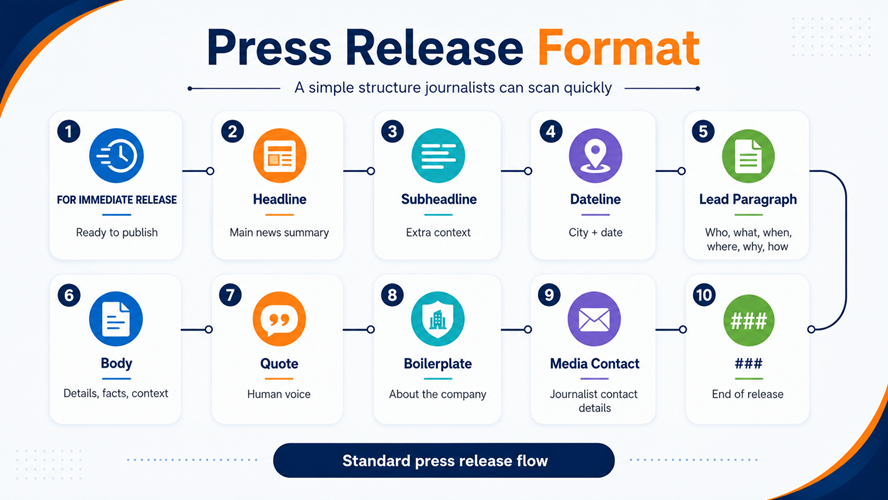
A professional press release follows a simple structure. This makes it easier for journalists to scan and use.
| Section | Purpose |
|---|---|
| FOR IMMEDIATE RELEASE | Tells media that the announcement can be published right away. |
| Headline | Summarizes the main news. |
| Subheadline | Adds extra context in one short line. |
| Dateline | Shows the city and date of the announcement. |
| Lead paragraph | Covers the main story using who, what, when, where, why, and how. |
| Body | Adds supporting details, facts, background, and context. |
| Quote | Adds a human voice from a spokesperson or expert. |
| Boilerplate | Gives a short company introduction. |
| Media contact | Provides contact details for journalists. |
| ### | Indicates the end of the press release. |
A standard press release format usually includes contact information, “For Immediate Release,” headline, subheadline, dateline, lead paragraph, supporting details, facts or figures, company boilerplate, media contact details, and three pound symbols at the end.
What to Include in a Press Release
A strong press release should include all the information a journalist needs to understand the announcement clearly. Each section has a specific purpose and helps make the press release complete, professional, and easy to use.
- Headline: The headline should be short, clear, and news-focused. It should quickly tell readers what the announcement is about.
- Subheadline: The subheadline adds extra context to the headline. It gives readers a little more detail and encourages them to continue reading.
- Dateline: The dateline includes the city, state or country, and the date of the announcement. It helps establish when and where the news is coming from.
- Lead Paragraph: The lead paragraph is the opening paragraph of the press release. It should answer the most important questions: who is involved, what happened, when it happened, where it happened, why it matters, and how it helps or works.
- Body: The body gives more detail about the announcement. It can include background information, product or service features, key data, customer impact, availability, and the next step readers should take.
- Quote: A quote adds credibility, personality, and a human voice to the press release. It is usually from a founder, CEO, spokesperson, project lead, or another relevant person.
- Boilerplate: The boilerplate is a short company description placed near the end of the press release. It explains what the company does, who it serves, and what its main mission or offering is.
- Media Contact: The media contact section gives journalists a clear person to reach out to for more information. It should include the contact person’s name, email address, phone number, website, and company details.
How to Write a Press Release
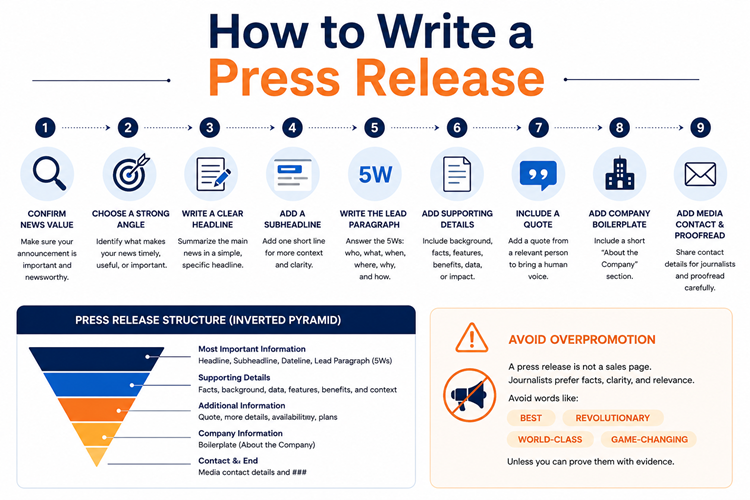
Writing a press release becomes much easier when you follow a clear process. Before you start writing, make sure your announcement has real news value. A press release should be written only when the information is important enough for journalists, customers, investors, or the public to care about.
Start by choosing a strong, newsworthy angle. This means identifying what makes your announcement important, timely, or useful. Once the angle is clear, write a headline that directly explains the main news. The headline should be simple, specific, and focused on the announcement.
After the headline, add a short subheadline to give readers more context. The subheadline should support the headline and give people one more reason to continue reading. Then, begin the first paragraph with the most important details. This opening paragraph should cover the 5Ws: who is involved, what happened, when it happened, where it happened, why it matters, and how it works or helps.
After the opening paragraph, add supporting details in the body of the press release. This can include background information, product or service features, key benefits, data, customer impact, availability, or plans. Keep the tone factual and avoid hype, exaggerated claims, or sales-heavy language. A press release should sound like a news announcement, not an advertisement.
Next, include a quote from a relevant person such as a founder, CEO, director, spokesperson, or project lead. A quote adds personality and gives the announcement a human voice. After that, add a short company boilerplate. This is a brief “About the Company” section that explains what the company does and who it serves.
At the end, include media contact details so journalists can easily follow up for more information. Add the contact person’s name, email, phone number, website, and company details. Before publishing or distributing the press release, proofread it carefully. Check spelling, grammar, names, dates, links, and formatting.
A good press release should be clear, concise, and easy to scan. Avoid long paragraphs and complicated language. The most important information should appear first, followed by supporting details, quotes, context, company information, and contact details. This structure is often called the inverted pyramid because it places the most important news at the top and the least urgent details near the end.
Avoid Overpromotion
A press release is not a sales page. Journalists prefer facts, clarity, and relevance. Avoid words like “best,” “revolutionary,” “world-class,” or “game-changing” unless you can prove them with evidence.
Press Release Template
Use this ready-to-copy press release template.
FOR IMMEDIATE RELEASE
[Company Name] Announces [Main News or Announcement]
[Short subheadline explaining why the announcement matters]
[City, Country, Date] — [Company Name], a [short company description], today announced [main announcement]. The announcement is designed to [explain purpose, benefit, or audience impact].
[Add more details about the announcement. Explain what is new, who it helps, why it matters, and how people can access it.]
“[Insert quote from founder, CEO, spokesperson, or expert],” said [Name], [Title] at [Company Name]. “[Add a natural quote that explains the vision, benefit, or importance of the announcement.]”
[Add supporting information, such as features, availability, pricing, event details, research findings, or next steps.]
About [Company Name]
[Company Name] is a [company description]. The company helps [target audience] with [main service, product, or mission].
Media Contact:
[Name]
[Title]
[Email]
[Phone]
[Website]
Press Release Examples
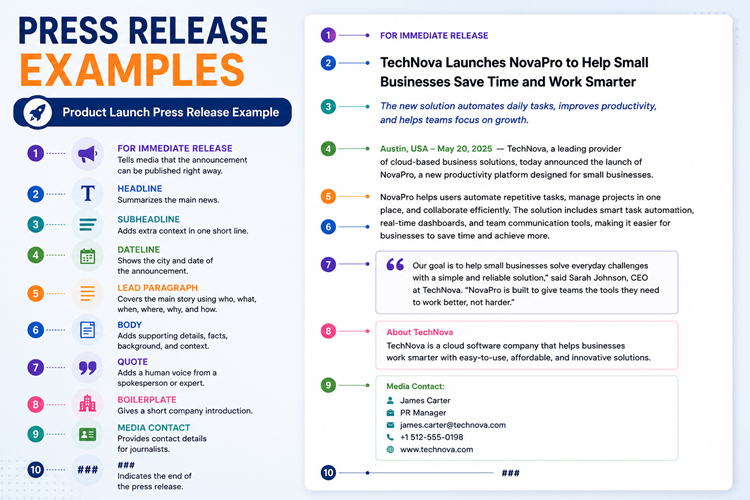
Product Launch Press Release Example
FOR IMMEDIATE RELEASE
[Company Name] Launches [Product Name] to Help [Target Audience] [Main Benefit]
The new solution helps [target audience] solve [specific problem] with [main feature or value].
[City, Country, Date] — [Company Name], a [company type or industry description], today announced the launch of [Product Name], a new [product/service type] designed for [target audience].
[Product Name] helps users [explain key benefit]. The solution includes [feature one], [feature two], and [feature three], making it easier for [target audience] to [desired outcome].
“Our goal is to help [target audience] solve [problem] with a simple and reliable solution,” said [Spokesperson Name], [Job Title] at [Company Name]. “[Add a short quote explaining the value or mission behind the launch.]”
[Product Name] is now available through [website/platform/location]. Customers can learn more at [Website URL].
About [Company Name]
[Company Name] is a [company type] that helps [target audience] with [main product, service, or mission].
Media Contact:
[Media Contact Name]
[Job Title]
[Email]
[Phone]
[Website]
Event Press Release Example
FOR IMMEDIATE RELEASE
[Event Name] to Bring [Target Audience] Together in [City]
The event will feature [speakers/sessions/workshops/networking opportunities] for [target audience].
[City, Country, Date] — [Organizer Name] today announced [Event Name], an upcoming event designed for [target audience]. The event will take place on [Event Date] at [Event Location].
[Event Name] will include [key activity one], [key activity two], and [key activity three]. The event aims to help attendees [main benefit or outcome].
“[Event Name] is designed to create meaningful opportunities for [target audience],” said [Spokesperson Name], [Job Title] at [Organizer Name]. “[Add a quote explaining why the event matters.]”
Registration is now open at [Registration URL].
About [Organizer Name]
[Organizer Name] is a [organization description] focused on [mission, audience, or industry].
Media Contact:
[Media Contact Name]
[Job Title]
[Email]
[Phone]
[Website]
Partnership Press Release Example
FOR IMMEDIATE RELEASE
[Company Name] Partners With [Partner Company Name] to [Main Partnership Goal]
The partnership will help [target audience] achieve [main benefit].
[City, Country, Date] — [Company Name], a [company description], today announced a partnership with [Partner Company Name], a [partner company description].
Through this partnership, both companies will work together to [explain what the partnership will do]. The collaboration is expected to help [target audience] by [explain benefit].
“This partnership supports our mission to [company mission or goal],” said [Spokesperson Name], [Job Title] at [Company Name]. “[Add a short quote about the partnership’s value.]”
The partnership will begin on [date/timeframe] and will be available to [target audience/location].
About [Company Name]
[Company Name] is a [company type] that helps [target audience] with [main solution].
About [Partner Company Name]
[Partner Company Name] is a [company type] focused on [main solution or mission].
Media Contact:
[Media Contact Name]
[Job Title]
[Email]
[Phone]
[Website]
Business Launch Press Release Example
FOR IMMEDIATE RELEASE
[Company Name] Officially Launches to Help [Target Audience] [Main Benefit]
The new business offers [product/service] for [specific audience or market].
[City, Country, Date] — [Company Name] today announced its official launch, offering [product/service] for [target audience]. The company aims to help [audience] solve [specific problem] through [main solution].
[Company Name] provides [service one], [service two], and [service three]. These services are designed to make [process/problem] easier, faster, or more effective for [target audience].
“We created [Company Name] to solve a real problem for [target audience],” said [Founder Name], Founder of [Company Name]. “[Add a quote about the company’s mission and future vision.]”
Customers can learn more about [Company Name] at [Website URL].
About [Company Name]
[Company Name] is a [business category] that helps [target audience] with [main service/product].
Media Contact:
[Media Contact Name]
[Job Title]
[Email]
[Phone]
[Website]
Pros and Cons of Press Releases
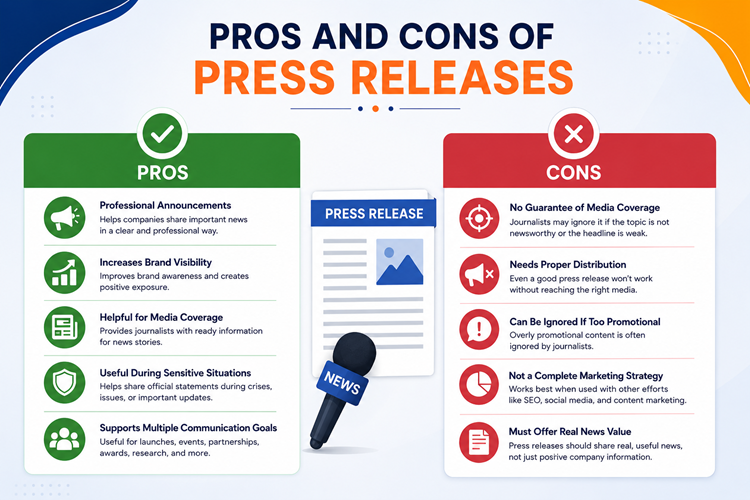
Press releases offer several benefits when they are written and distributed properly. They help companies announce important news professionally and provide journalists with ready information for media coverage. A well-written press release can also improve brand visibility, support public communication, and create positive exposure for a business, product, event, or announcement.
Another major advantage of a press release is that it can help during sensitive situations. When a company needs to respond to a public issue, crisis, or important update, a press release allows the brand to share an official statement in a clear and structured format. This helps reduce confusion and keeps the message consistent.
However, press releases also have some limitations. A press release does not guarantee media coverage. Journalists may ignore it if the topic is not newsworthy, the headline is weak, or the announcement feels too promotional. Even a well-written press release needs proper distribution to reach the right media outlets and audience.
Press releases can help create buzz and positive exposure, but they should not be treated as a complete marketing strategy. They work best when used as part of a broader communication plan that includes media outreach, SEO, social media, content marketing, and brand-building efforts. To be effective, a press release should offer real news value, not just positive company information.
Press Release vs Media Alert vs Press Statement vs Press Conference
| Communication Type | Meaning | Best For | Format |
|---|---|---|---|
| Press Release | A complete written announcement shared with the media | Product launches, partnerships, funding, events, company news | Detailed written story |
| Media Alert | A short notice inviting media to an event | Press conferences, live events, media briefings | Short who, what, when, where, why format |
| Press Statement | A short official response or comment | Crisis response, clarification, public issue | Brief statement |
| Press Conference | A live event where media can ask questions | Major announcements, crisis communication, public briefings | Live and interactive |
A press release delivers a full story. A media alert invites journalists to attend something. A press statement gives a short official response. A press conference allows live media interaction.
Press Release Distribution
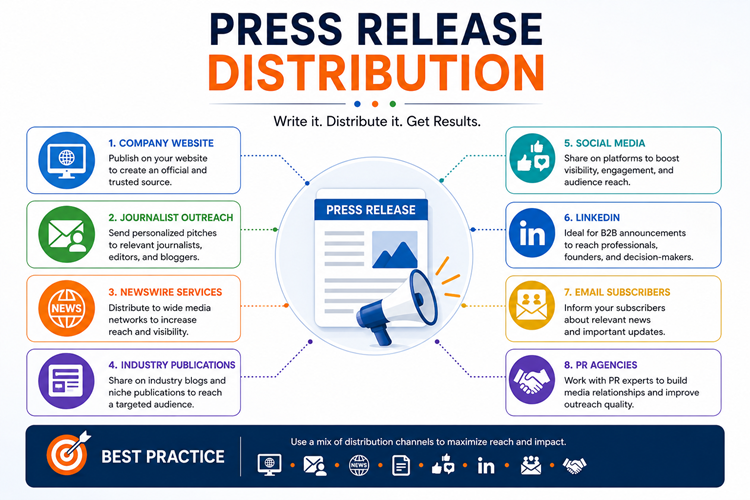
Writing a press release is only half the work. To get results, you also need to distribute it properly. A press release will not create visibility on its own unless it reaches the right journalists, media outlets, industry platforms, and audience.
One of the first places to publish a press release is your own company website. This creates an official source for the announcement and gives readers, journalists, and search engines a reliable page to refer to. If your website has a newsroom or media section, you can publish all company announcements there so that your brand news stays organized in one place.
Direct email outreach is another important distribution method. You can send the press release to relevant journalists, editors, bloggers, and industry writers who cover your niche. Instead of sending the same message to everyone, it is better to personalize the pitch and explain why the announcement is useful for their audience.
Newswire services can also be used to distribute a press release to wider media networks. These services help increase reach, but they should not be the only distribution method. For better results, combine them with targeted journalist outreach, owned media, and social sharing.
Industry blogs and niche publications are also useful for press release distribution because they help you reach a more specific audience. Social media platforms can increase visibility and engagement, especially when the announcement is relevant to customers, followers, or industry communities. For B2B announcements, LinkedIn can be especially useful because it helps reach professionals, founders, decision-makers, and business audiences.
Email subscribers can also be informed about major announcements if the news is relevant to them. In some cases, companies may also work with PR agencies to manage media relationships, prepare journalist lists, and improve outreach quality.
Common press release distribution methods include company websites, newsroom pages, journalist outreach, newswire services, industry publications, social media, LinkedIn, email subscribers, and PR agencies. The best results usually come from using a mix of these channels instead of relying on only one.
Simple Distribution Workflow
A simple press release distribution workflow starts with proper preparation. Before sending the press release anywhere, finalize the content, check all facts, add the correct media contact details, and prepare supporting assets such as images, logos, screenshots, videos, or documents. These assets make it easier for journalists to understand and cover the announcement.
After preparing the press release, build a targeted media list. Find journalists, editors, bloggers, and industry publications that regularly cover your niche. Sending the release to the right people is more effective than sending it to a large but irrelevant list.
Next, personalize your pitch. Instead of sending only the press release, write a short email explaining why the story matters and why it is relevant to that journalist’s audience. A personalized pitch can increase the chances of getting attention.
Once the pitch is ready, send the press release clearly. You can paste the release in the email body, attach it as a document, or link to the official version on your website. Make sure the journalist can quickly understand the announcement and access all important details.
After sending the release, follow up politely after a few days if you do not get a response. The follow-up should be short, professional, and helpful. Avoid sending too many follow-ups because that can look spammy.
You should also publish the press release on your own website, preferably in a newsroom, press, or blog section. This creates an official source for the announcement. After publishing, share the release on relevant social platforms such as LinkedIn, X, Facebook, and industry communities.
Finally, track the results. Monitor media pickups, website traffic, referral visits, brand mentions, backlinks, social engagement, and any leads or inquiries that come from the announcement. This helps you understand whether the press release worked and what can be improved next time.
Press Release SEO Tips
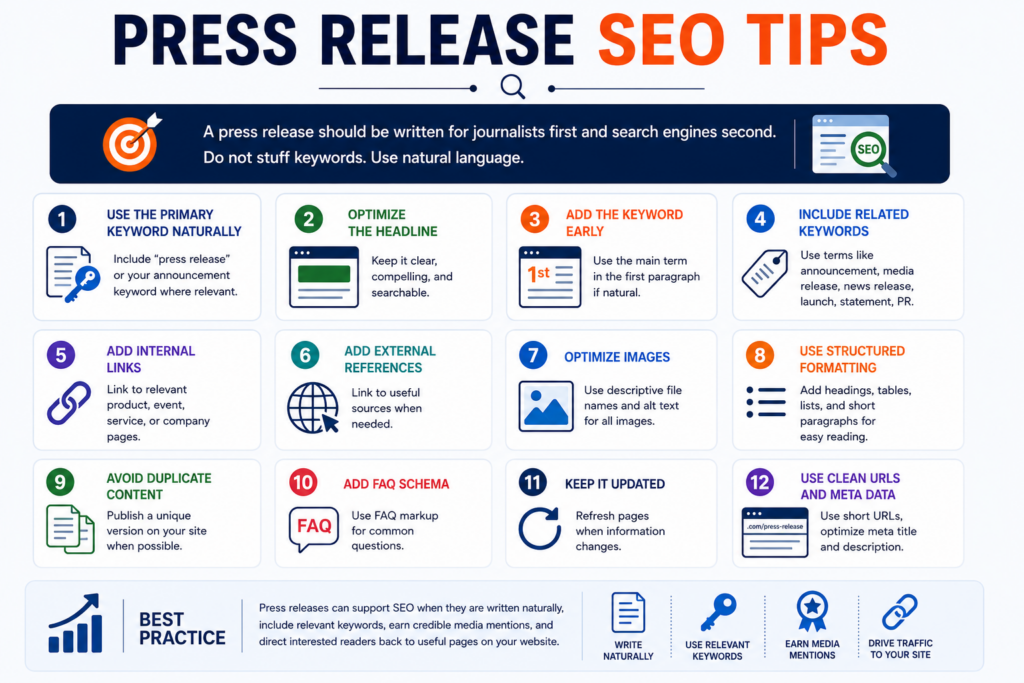
A press release should be written for journalists first and search engines second. Do not stuff keywords. Use natural language.
| SEO Tip | How to Apply It |
|---|---|
| Use the primary keyword naturally | Include “press release” or your announcement keyword where relevant. |
| Optimize the headline | Keep it clear and searchable. |
| Add the keyword early | Use the main term in the first paragraph if natural. |
| Include related keywords | Use terms like announcement, media release, news release, launch, statement, and PR. |
| Add internal links | Link to relevant product, event, service, or company pages. |
| Add external references | Link to useful sources when needed. |
| Optimize images | Use descriptive file names and alt text. |
| Use structured formatting | Add headings, tables, and short paragraphs. |
| Avoid duplicate content | Publish a unique version on your site when possible. |
| Add FAQ schema | Use FAQ markup for common questions. |
| Keep it updated | Refresh pages when information changes. |
Press releases can support SEO when they are written naturally, include relevant keywords, earn credible media mentions, and direct interested readers back to useful pages on your website.
Common Press Release Mistakes
Many press releases fail because they are written like advertisements instead of news announcements. One of the most common mistakes is making the press release too promotional. Journalists usually look for useful, timely, and factual information, so the focus should be on news value rather than sales language.
Another common mistake is using a weak headline. If the headline does not clearly explain the announcement, readers may not understand why the story matters. A strong headline should be specific, direct, and focused on the main news.
A press release can also fail when it has no real news value. Before writing, ask why the audience should care about the announcement. If the answer is not clear, the topic may need a stronger angle or more useful context.
Missing the 5Ws is another issue. A complete press release should answer who is involved, what happened, when it happened, where it happened, why it matters, and how it works or helps. Without these details, the story may feel incomplete.
Long paragraphs can also reduce readability. Journalists and readers should be able to scan the release quickly, so short paragraphs and clear sentences work better. A press release should be easy to understand on the first read.
Another mistake is not including a quote. A relevant quote from a founder, CEO, spokesperson, or project lead adds personality and gives the announcement a human voice. Without a quote, the press release can feel flat or incomplete.
Missing contact details is a serious problem because journalists need a clear way to follow up. Always include the media contact person’s name, email address, phone number, website, and company details.
Using too much industry jargon can confuse readers. Even if the announcement is technical, the language should still be simple and clear. A good press release should be understandable to journalists, customers, and general readers.
Many companies also forget to plan distribution. Even a well-written press release needs the right outreach strategy. Build a targeted media list, prepare a short pitch, and share the release through relevant channels.
Finally, poor proofreading can reduce credibility. Before publishing or sending the press release, check spelling, grammar, names, dates, links, numbers, and formatting. A polished press release looks more professional and trustworthy.
How to Measure Press Release Success
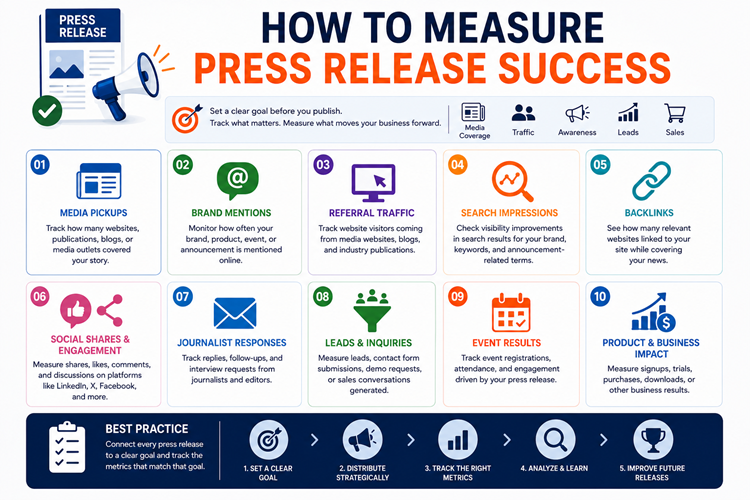
A press release should always have a clear goal before it is published or distributed. The goal may be media coverage, website traffic, brand awareness, event registrations, product signups, investor attention, or customer inquiries. Once the press release is distributed, you should measure whether it helped achieve that goal.
One of the most important ways to measure success is by tracking media pickups. This shows how many websites, publications, blogs, or media outlets covered the story. If multiple relevant outlets publish or mention the announcement, it means the press release reached the right audience.
Brand mentions are also useful to monitor. They show how often your company, product, event, or announcement was mentioned online after the press release was distributed. These mentions can help improve brand visibility and public awareness.
Referral traffic is another important metric. If media websites or industry blogs link to your website, you can track how many visitors came from those links. This helps you understand whether the press release brought interested readers to your site.
Search impressions can show whether your announcement improved visibility in search results. If more people are seeing your brand name, product name, or announcement-related keywords after the release, it may be a sign that the press release helped your online presence.
Backlinks are also valuable because they show whether other websites linked to your website while covering the story. Relevant backlinks can support authority, referral traffic, and long-term visibility.
Social shares and engagement help you understand how people reacted to the announcement on platforms like LinkedIn, X, Facebook, and other communities. If the press release gets shared, commented on, or discussed, it means the topic created interest.
Email responses from journalists are another strong signal. Even if the release is not published immediately, replies from journalists can lead to interviews, follow-up questions, or future coverage opportunities.
You can also track business-focused results such as leads, inquiries, demo requests, event registrations, product signups, downloads, or sales conversations. These metrics show whether the press release created real business interest beyond visibility.
For event press releases, registrations and attendance are important success indicators. For product launch press releases, signups, trials, purchases, or demo requests can show how well the announcement performed. The best way to measure success is to connect each press release to a clear goal and track the metrics that match that goal.
Common Misconceptions
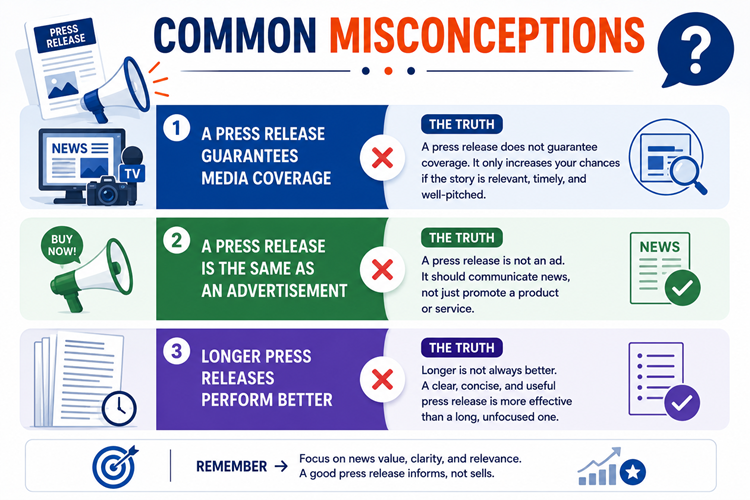
1. A press release guarantees media coverage
A press release does not guarantee coverage. It only increases your chances if the story is relevant, timely, and well-pitched.
2. A press release is the same as an advertisement
A press release is not an ad. It should communicate news, not just promote a product or service.
3. Longer press releases perform better
Longer is not always better. A clear, concise, and useful press release is more effective than a long, unfocused one.
Final Thoughts
A press release is one of the most useful tools in public relations. It helps companies and organizations share important news with journalists, media outlets, customers, investors, and the public.
The best press releases are clear, factual, newsworthy, and easy to understand. They follow a professional format, include a strong headline, answer the 5Ws, provide useful details, add a meaningful quote, and include proper media contact information.
To get the best results, do not treat a press release like an advertisement. Treat it like a news story. Focus on what happened, why it matters, who it helps, and how the media can cover it.
Frequently Asked Questions About Press Release
Q1. What is a press release?
Answer: A press release is an official written announcement sent to journalists, editors, media outlets, or the public to share important news about a company, organization, event, product, or update.
Q2. What is the purpose of a press release?
Answer: The purpose of a press release is to communicate newsworthy information, attract media attention, build brand visibility, and provide journalists with accurate details for potential coverage.
Q3. What is the standard press release format?
Answer: A standard press release includes “For Immediate Release,” headline, subheadline, dateline, lead paragraph, body, quote, company boilerplate, media contact details, and “###” at the end.
Q4. How do you write a press release?
Answer: To write a press release, choose a newsworthy angle, write a clear headline, answer the 5Ws in the first paragraph, add supporting details, include a quote, add company information, and provide media contact details.
Q5. How long should a press release be?
Answer: A press release should usually be concise and focused. Many effective press releases are around one page, but the ideal length depends on the announcement and the details needed.
Q6. Is a press release good for SEO?
Answer: A press release can support SEO by improving brand visibility, earning media mentions, generating referral traffic, and helping people discover your announcement online. It should not be used only for backlinks.
Q7. What is the difference between a press release and a media alert?
Answer: A press release is a complete news announcement. A media alert is a short invitation or notice that tells journalists about an upcoming event or media opportunity.
Q8. What should not be included in a press release?
Answer: Avoid exaggerated claims, keyword stuffing, unsupported statistics, long sales pitches, irrelevant details, and private information that should not be public.
Q9. Where should I submit a press release?
Answer: You can publish it on your website, send it to relevant journalists, distribute it through newswire services, share it on social media, and pitch it to industry publications.
Q10. Do startups need press releases?
Answer: Yes, startups can use press releases for major announcements such as funding, product launches, partnerships, events, awards, and expansion updates.