

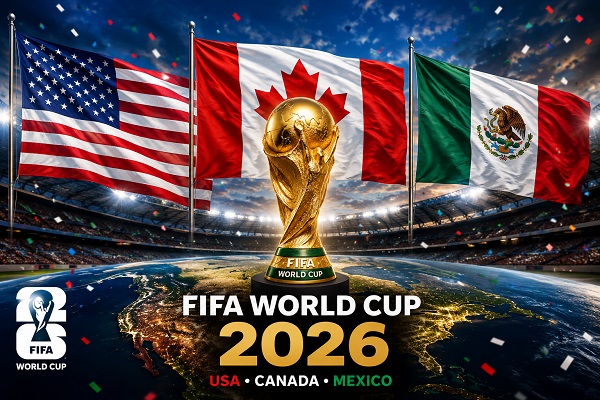
The FIFA World Cup 2026 is not just another edition of football’s biggest tournament. It is a historic moment for the sport, for FIFA, and for North America. For the first time, the tournament is being hosted by three nations together: the United States, Canada, and Mexico.
This also makes it the first men’s FIFA World Cup co-hosted by multiple nations since Japan and South Korea in 2002. But the real story is not only about three countries sharing matches. It is about how three football federations joined forces, built a powerful bid, defeated Morocco, and convinced FIFA that North America was ready to host the biggest World Cup ever.
Truth Box
| Key Point | Insight |
|---|---|
| First Three-Nation Host | USA, Canada, and Mexico became the first three countries to jointly host a FIFA World Cup. |
| Historic Vote | The United Bid won 134 votes compared to Morocco’s 65 at the FIFA Congress in Moscow in 2018. |
| Expanded Tournament | The 2026 edition became the first FIFA World Cup with 48 teams. |
| Existing Infrastructure | The bid relied heavily on stadiums, airports, hotels, and facilities that were already available. |
| Mexico’s Historic Role | Mexico became the first country to host the men’s FIFA World Cup three times. |
How the 2026 FIFA World Cup Bid Began
The journey toward the 2026 FIFA World Cup began during a period when FIFA was trying to rebuild trust in its bidding process. After years of controversy around World Cup hosting decisions, the organization introduced a more open and transparent voting model.
Instead of bidding separately, the football federations of the United States, Canada, and Mexico saw a bigger opportunity. They understood that a tournament expanding to 48 teams would need more cities, more stadiums, more hotels, and stronger transport systems. A joint bid gave them the scale that one nation alone may have found harder to offer.
The United Bid was officially launched in 2017. From the beginning, it was built around one clear message: North America already had the infrastructure, the commercial strength, and the football ambition to deliver a successful World Cup.
Why Three Nations Joined Forces
Hosting the World Cup is no longer only about passion for football. It is also about airports, stadiums, security, hotels, training centers, broadcast facilities, transport networks, and financial planning. A bigger World Cup means a bigger operational challenge.
The United States brought large stadiums, a huge sports market, and strong commercial potential. Mexico brought deep football history, passionate fans, and previous World Cup hosting experience from 1970 and 1986. Canada added modern cities, growing football culture, and the chance to bring the men’s World Cup to Canadian soil for the first time.
Together, the three nations created a bid that looked practical, profitable, and relatively low-risk.
| Requirement | Why It Mattered |
| Stadiums | The expanded tournament needed multiple world-class venues. |
| Airports | Fans, teams, media, and officials needed strong travel access. |
| Hotels | Host cities needed enough accommodation for global visitors. |
| Transport | Large crowds required reliable city and regional movement. |
| Security | A multi-city tournament needed strong coordination. |
The Battle Against Morocco
The United Bid’s main rival was Morocco. Morocco had football passion, regional support, and a strong desire to bring the World Cup back to Africa. It was not a weak bid emotionally or culturally.
But FIFA’s evaluation process focused heavily on practical delivery. The key questions were simple. Which bid had more existing infrastructure? Which bid carried less financial risk? Which bid could handle a larger 48-team tournament more easily?
That is where the United Bid gained a major advantage. North America did not need to build an entire tournament system from scratch. Many venues, hotels, airports, and sports facilities were already in place.
The Winning Formula Behind the United Bid
The biggest strength of the United Bid was readiness. FIFA voters saw a proposal that did not depend heavily on future construction promises. The bid offered large stadiums, established cities, advanced broadcast capacity, and a huge commercial market.
Money also mattered. The World Cup is FIFA’s biggest event, and the North American market offered strong ticketing, sponsorship, media, and hospitality potential. This made the bid attractive not only from a sporting view but also from a business view.
Another major factor was the tournament format. The 2026 World Cup expanded from 32 teams to 48 teams. That meant more matches, more teams, and more pressure on the host system. A three-country bid made that expansion easier to manage.
How FIFA Voted
The final vote took place on June 13, 2018, during the 68th FIFA Congress in Moscow. FIFA member associations voted between the United Bid and Morocco.
The result was clear. The United Bid won with 134 votes, while Morocco received 65 votes. One vote went to “none of the bids.” This gave the USA, Canada, and Mexico the right to host the FIFA World Cup 2026.
| Bid | Votes |
| USA, Canada & Mexico | 134 |
| Morocco | 65 |
| None of the Bids | 1 |
What Makes the 2026 World Cup Historic
The 2026 edition is historic for several reasons. It is the first FIFA World Cup hosted by three countries. It is also the first men’s World Cup co-hosted by multiple nations since 2002, when Japan and South Korea hosted the tournament together.
It is also the first World Cup with 48 teams. That expansion changes the scale of the event completely. More teams means more matches, more fans, more cities, and more global attention.
Mexico also gains a special place in football history. After hosting in 1970 and 1986, Mexico becomes the first country to host the men’s FIFA World Cup three times.
| Historic Achievement | Significance |
| Three Host Nations | First FIFA World Cup hosted by three countries |
| 48 Teams | Largest tournament format in World Cup history |
| Mexico’s Third Hosting | Mexico becomes the first country to host three men’s World Cups |
| Multiple Host Cities | The tournament spreads across North America |
| First Since 2002 | First men’s World Cup co-hosted by multiple nations since Japan and South Korea |
Impact on North American Football
The FIFA World Cup 2026 is expected to have a long-term impact on football across North America. In the United States, it can push the sport further into the mainstream. In Canada, it can strengthen the country’s growing football culture. In Mexico, it renews the country’s deep connection with World Cup history.
The event can also inspire young players, increase investment in football infrastructure, and attract more attention to domestic leagues. Major League Soccer, Liga MX, and Canadian football development may all benefit from the visibility of the tournament.
For fans, the biggest impact is emotional. The World Cup gives local supporters a chance to experience the tournament not as distant viewers, but as hosts.
Comparison: United Bid vs Morocco Bid
| Factor | United Bid | Morocco Bid |
| Host Countries | 3 | 1 |
| Existing Stadiums | Extensive | More development required |
| Commercial Market | Very large | Smaller global commercial reach |
| Previous Hosting Experience | Strong, especially through USA and Mexico | No men’s World Cup hosting history |
| Tournament Capacity | High | More infrastructure pressure |
| Final Vote Result | 134 | 65 |
Industry Context and the Future of Mega-Tournaments
The success of the United Bid showed that future mega-tournaments may not always need to depend on one host nation. Shared hosting can reduce pressure, spread costs, and allow more countries to benefit from global exposure.
For FIFA, the 2026 model also fits the modern direction of football. The tournament is bigger, more commercial, and more complex than ever before. A multi-country format gives organizers more flexibility.
The United Bid may become a model for future sporting events where scale, infrastructure, and financial planning are just as important as football tradition.
Common Misconceptions
Myth: The United States won the bid alone
The United States played a major role, but the bid was a joint effort by the USA, Canada, and Mexico. All three countries are official hosts of the FIFA World Cup 2026.
Myth: Morocco lost because it lacked football passion
Morocco has a strong football culture. The difference came mainly from infrastructure readiness, financial strength, and FIFA’s risk assessment.
Myth: Co-hosting is completely new for the World Cup
Co-hosting has happened before. Japan and South Korea hosted the men’s FIFA World Cup in 2002. What makes 2026 different is that it is the first edition hosted by three countries.
Conclusion
The story of the FIFA World Cup 2026 bid is the story of strategy, cooperation, and timing. The United States, Canada, and Mexico understood that the future of the World Cup was becoming bigger than any one country’s ambition.
By joining forces, they offered FIFA a bid that was practical, commercially powerful, and ready for the demands of a 48-team tournament. Their victory over Morocco was not just a hosting decision. It was a signal that the World Cup had entered a new era.
Three nations. One tournament. One historic moment for football.
Frequently Asked Questions
Q1. Why is the FIFA World Cup 2026 hosted by three countries?
Ans. The tournament expanded to 48 teams, which created a need for more venues, more accommodation, and stronger logistics. A three-country bid made that easier to deliver.
Q2. Which countries are hosting the FIFA World Cup 2026?
Ans. The FIFA World Cup 2026 is hosted by the United States, Canada, and Mexico.
Q3. When did USA, Canada, and Mexico win the 2026 World Cup bid?
Ans. They won the bid on June 13, 2018, during the 68th FIFA Congress in Moscow.
Q4. Who did the United Bid defeat?
Ans. The United Bid defeated Morocco in the final FIFA vote.
Q5. Why is Mexico’s role historic?
Ans. Mexico became the first country to host the men’s FIFA World Cup three times, after previously hosting in 1970 and 1986.